Showing posts with label literature. Show all posts

Sunday, September 18, 2011

a question on Romeo and Juliet

Alright, I think there's an important question I've been missing so far even though I've read this scene a lot of times.

ROMEO
If I profane with my unworthiest hand
This holy shrine, the gentle fine is this:
My lips, two blushing pilgrims, ready stand
To smooth that rough touch with a tender kiss.
JULIET
Good pilgrim, you do wrong your hand too much,
Which mannerly devotion shows in this;
For saints have hands that pilgrims' hands do touch,
And palm to palm is holy palmers' kiss.
ROMEO
Have not saints lips, and holy palmers too?
JULIET
Ay, pilgrim, lips that they must use in prayer.
ROMEO
O, then, dear saint, let lips do what hands do;
They pray, grant thou, lest faith turn to despair.
JULIET
Saints do not move, though grant for prayers' sake.
ROMEO
Then move not, while my prayer's effect I take.
(Romeo and Juliet, I.v; emphasis mine)


This is a lovely little witty exchange, and it's a sonnet where both the male lover and the female beloved get to speak, which is pretty unusual and nifty.  And they're both adept at taking the initial pilgrimage metaphor and turning it in different directions.

But what I want to know now is -- Do saints have hands which pilgrims' hands do touch?  Doesn't a saint have to be dead before she is declared a saint and has pilgrims visiting her shrine?

Now, it could be that Shakespeare is being Protestant here and considering any Christian a saint, rather than only those who have been officially declared saints posthumously -- and in that case, a saint could be alive.  However, if that's what he's doing, then it's an odd mix with the language of pilgrimages and palmers and saints granting prayers.  Do people go on pilgrimages to see living saints?  I guess one could go and ask advice from Julian of Norwich in her anchorite cell, but that seems a bit different from a palmer's pilgrimage to a shrine.  Even if the saint can be alive, the line is a lot weirder than I thought, and I need to figure out what's going on.

But if the saint has to be dead, things definitely get creepy in the middle of the pretty love scene.  For one thing, touching a dead saint's hands at all might be difficult, if the saint's remains are buried or locked away.  And if the holy palmer's kiss (where saints have hands that pilgrims' hands do touch) means touching a statue's hand or fingering mummified saints' digits in a reliquary -- well then!  That makes for quite a different image from what I thought it was.  And also, it could foreshadow the end, where Romeo does kiss Juliet believing her to be dead, and the survivors set up memorial statues.  Also, her apparent corpse is in great condition when Romeo finds her.  We know that that's because it's not really a corpse and she's only under the influence of the sleeping potion -- but does Romeo think it's because she's a saint and her body is therefore not decaying?

I shall have to see if anyone more knowledgeable has already tackled this thoroughly.  If not, then term paper time for me!  First up, I need to look into concepts of sainthood in England circa 1595.  After which, another look at the text and see just how close to canonization Juliet might be.  Hmmmm, says I.  

Saturday, October 03, 2009

speech scrolls


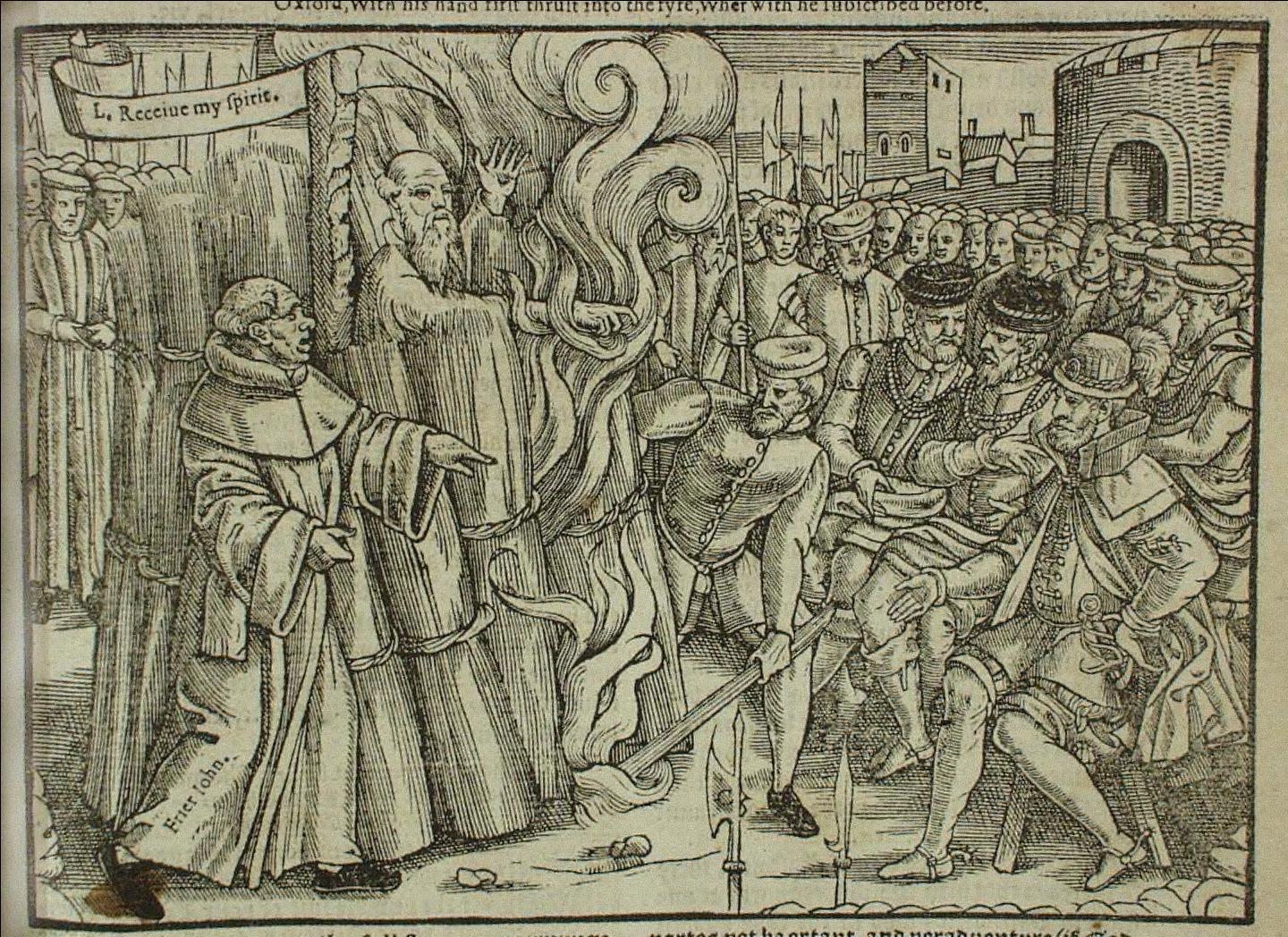
Way back before comic books, there were speech scrolls. This is a woodcut from Foxe's Book of Martyrs, circa 1563. Notice how the scroll comes from the general direction of Cranmer's face. Also, notice the written label on the monk's robe in the bottom left. Here are links to some more woodcuts with speech scrolls from the same book. (Warning: This last one isn't a good idea if you're squeamish or trying to eat -- yes, that is his arm bone down there.)

You may ask, is this why I'm in grad school? Gory renaissance proto-comics? Well, friends, I don't know either.

Friday, March 13, 2009

Oh hey, I do have a blog.

So, I'm reading Ian McEwan's Atonement now. I'm not sure what I think of it just yet, but here's a really neat part near the beginning. This is where a thirteen-year-old aspiring authoress is digesting an existential epiphany.

"She need only show separate minds, as alive as her own, struggling with the idea that other minds were equally alive. It wasn't only wickedness and scheming that made people unhappy, it was confusion and misunderstanding; above all, it was the failure to grasp the simple truth that other people are as real as you. And only in a story could you enter these different minds and show how they had an equal value."

This is one of the main reasons literature is worthwhile. As humans trying to interact meaningfully (and trying to obey a specific order to love our neighbors as ourselves), we have to try to think of other people as just as real as we are. And that's hard to do, because we have the senses and details of our own existence, but not anyone else's. And it's also hard because it means we have to deal with other people's needs as well as our own, and that's a lot of work. But literature helps with this, because we get to practice experiencing other people's existential realities. We get to go into what matters to another person and how her psyche deals with things when we read what she's written. And once we get used to doing that in reading, I think we can do a better job of it in real life too.


Tuesday, June 24, 2008

Doh.

So, I'm working on memorizing T.S. Eliot's "Four Quartets." I just Googled a quote Eliot uses to see where it's taken from. Here's what I searched:

"on whatever sphere of being the mind of a man may be intent at the time of death"

And Google kindly provided me with this suggestion:

Did you mean: "on whatever sphere of being the mind of a man may be internet at the time of death" ?

Irony is a beautiful thing.

Wednesday, March 05, 2008

Ode on a Golden Bundt Spice Cake With Lemon Glaze

So, today I meant to write a midterm essay for American Short Story, but instead I learned how to smoke a brisket and baked an exceptionally beautiful spice cake.

I don't think John Keats had thought about spice cakes when he wrote "A thing of beauty is a joy forever." Spice cakes embody transient mortal beauty, more valuable simply because of its impermanence.

Really, Keats should've written an ode on a spice cake to explore this angle of the aesthetic experience. But no, spice cakes aren't romantic enough for him. He has to write about seasons and birdwatching and pottery, when there are beautiful spice cakes in the world unimmortalized by verse.

But wait -- if he immortalized a spice cake, he'd be missing the point of its fleeting beauty, violating the very ephemerality which sharpens its significance.

So. . . maybe Keats actually wrote a poem about spice cakes by not writing a poem about them. His conspicuous silence on the subject actually proves his reverence and appreciation for the evanescent beauty of spice cakes.

(This ramble is indebted to this poem. Also, forgive my ridiculousness; my blog looked lonely and so I posted on it.)

Saturday, February 09, 2008

Mother Deities

So, this last week I've encountered two songs that refer to meeting one's mother in heaven. One of them ("Poor Wayfaring Stranger") says in one verse "I'm going there to meet my Father" and in another verse "I'm going there to meet my mother" (note the capitalization). God takes the father role, but the mother is just a human mother rather awkwardly placed as a heavenly figure.

The divinity of fathers is understood to be metaphorical and refer imperfectly to God's divinity, but mothers don't have anywhere to pass the buck in protestant culture. I'm taking Victorian Literature, and the strain is especially acute in that period. Victorian mothers are supposed to be superhuman agents of goodness, taking care of their own work and everyone else's, and generally glowing with virtue. I'm not saying mothers or anyone else ought to slack off on virtue and goodness, but the expectations were pretty ridiculous and still are in many subcultures.

If we have a psychological or cultural need for a divine mother, promoting earthly mothers to the position isn't a fair way to deal with it. And it's not healthy for them or those around them. A mother who thinks she's supposed to be an angel or goddess is likely to be acutely disappointed with herself, or self-righteous, or both. Idealizing human roles gets messy very quickly.

So maybe we need to recognize the mother aspect in God more. Mothers should be able to see what they do as a reflection of (not a substitute for) the mother in God. Then mothering is meaningful but allowed to be imperfect, and mothers can respect themselves and be respected for what they are.

Monday, January 14, 2008

Existentialist Blind Dates

I think someone should've arranged a meeting between Fyodor Dostoevsky and Emily Dickinson. It would've been chronologically possible.

Since they're both dead now, though, I'd settle for a Tom Stoppard play based on the scenario.

Thursday, December 20, 2007

Poem Intersections

I like it when poems come together (accidentally or on purpose). So I think I shall post poetry quotes that seem to intersect; perhaps it'll become a frequent feature on this blog.

The wounded surgeon plies the steel
That questions the distempered part;
Beneath the bleeding hands we feel
The sharp compassion of the healer's art
Resolving the enigma of the fever chart.
- Eliot

A Wounded Deer -- leaps highest --
I've heard the Hunter tell --
Tis but the Ecstasy of death --
And then the Brake is still!

. . .

Mirth is the Mail of Anguish --
In which it Cautious Arm,
Lest anybody spy the blood
And "you're hurt" exclaim!
- Dickinson

Tuesday, December 11, 2007

Dazzling and Tremendous

"Dazzling and tremendous how quick the sun-rise would kill me,
If I could not now and always send sun-rise out of me."
- Whitman

I love those lines very much indeed. But I think I may disagree with what Whitman is saying (if I've understood it). I don't think the sunrise would be a mortal danger if he couldn't send sunrise out of himself. Rocks or animals aren't in danger of being killed by dazzling tremendousness, but people are -- because they have the capacity to respond to dazzling tremendousness in its own terms.

Our weakness, our capacity to be injured by our surroundings, comes from a strength, our capacity to respond deeply to our surroundings.

(To go back to Whitman, though, perhaps he's saying he'd be overcome if he only responded internally and lacked the power to express his encounters -- and the context (section 25 of "Song of Myself") suggests that that might be on track.)

Sunday, November 18, 2007

It is Margaret you mourn for.

Ok, here's the further digression. I saved it as a draft and didn't come back to finish it.

MÁRGARÉT, áre you gríeving
Over Goldengrove unleaving?
Leáves, líke the things of man, you
With your fresh thoughts care for, can you?
Áh! ás the heart grows older 5
It will come to such sights colder
By and by, nor spare a sigh
Though worlds of wanwood leafmeal lie;
And yet you wíll weep and know why.
Now no matter, child, the name: 10
Sórrow’s spríngs áre the same.
Nor mouth had, no nor mind, expressed
What heart heard of, ghost guessed:
It ís the blight man was born for,
It is Margaret you mourn for.

-- G.M. Hopkins

Margaret is crying about leaves, but she's also crying about mortality. We as people channel the emotional force of abstract and general situations into specific symbols. That's one reason that poetry matters. Specific words, syntax, sound touch a reader because they aren't just words -- they evoke things that matter deeply that we can't access without words. Or maybe we do access them internally, but the words help us to commune with other people about them and be pierced or comforted by the understanding that someone else also knows about this. Poetry channels forces that are too big or too confusing for us to confront without it.