Lately I've been in awe of the act of writing. I regularly ask myself (and nowadays my students) to do something very nearly miraculous. I don't know how it works, but I've developed an almost reckless trust that it does.
So, I've got a blank page and no idea what I'm going to say, but then I start saying something anyway, and sometimes it turns out to be something meaningful and exciting. And sure, it doesn't come out of nowhere -- I draw on lots of past experiences and thoughts to make it happen. But still, the sheer gall of thinking, "I now have no clue where I'm going with this, but 3 hours from now I absolutely am going to have a decent draft of whatever it is" is baffling when you think about it. How do we know it'll work? Yeah, there are deliberate things we can do to foster it -- brainstorming, associations, freewriting, whatever -- but what guarantees that anything will actually come together? Nothing I know of, and yet it happens every time. The quality of my writing definitely varies, but every single time professors have assigned me to write a paper, I've written one. And every time I decide to make myself write, I write something. It's crazy!
I have mixed feelings about how academia forces writing and ideas. When there's pressure to generate material, a lot of it is likely to be inauthentic and written just because we've got a deadline to meet even if we don't care about what we're saying. And the whole reification of ideas is weird -- who thought it was a good plan to assign complex and multidirectional expressions of thought a numeric value? or to use relatively arbitrary writing requirements as a barrier to achieving status? But one thing I'll say in favor of the academic writing situation: It does build faith in whatever miracle we rely on when we write. If I hadn't been required to write regularly, I might not even know that writing can happen on demand. I might be stuck writing only in the conjunction of propitious moods when I felt energetic and thoughtful at the same time. But (largely because of academic writing) I instead know that I can force writing under almost any psychological conditions. And sometimes forced writing can be dang good, too.
Writing is a weird hybrid of hard work and magic. More on that later, perhaps.
Tuesday, October 13, 2009

Saturday, October 03, 2009
speech scrolls
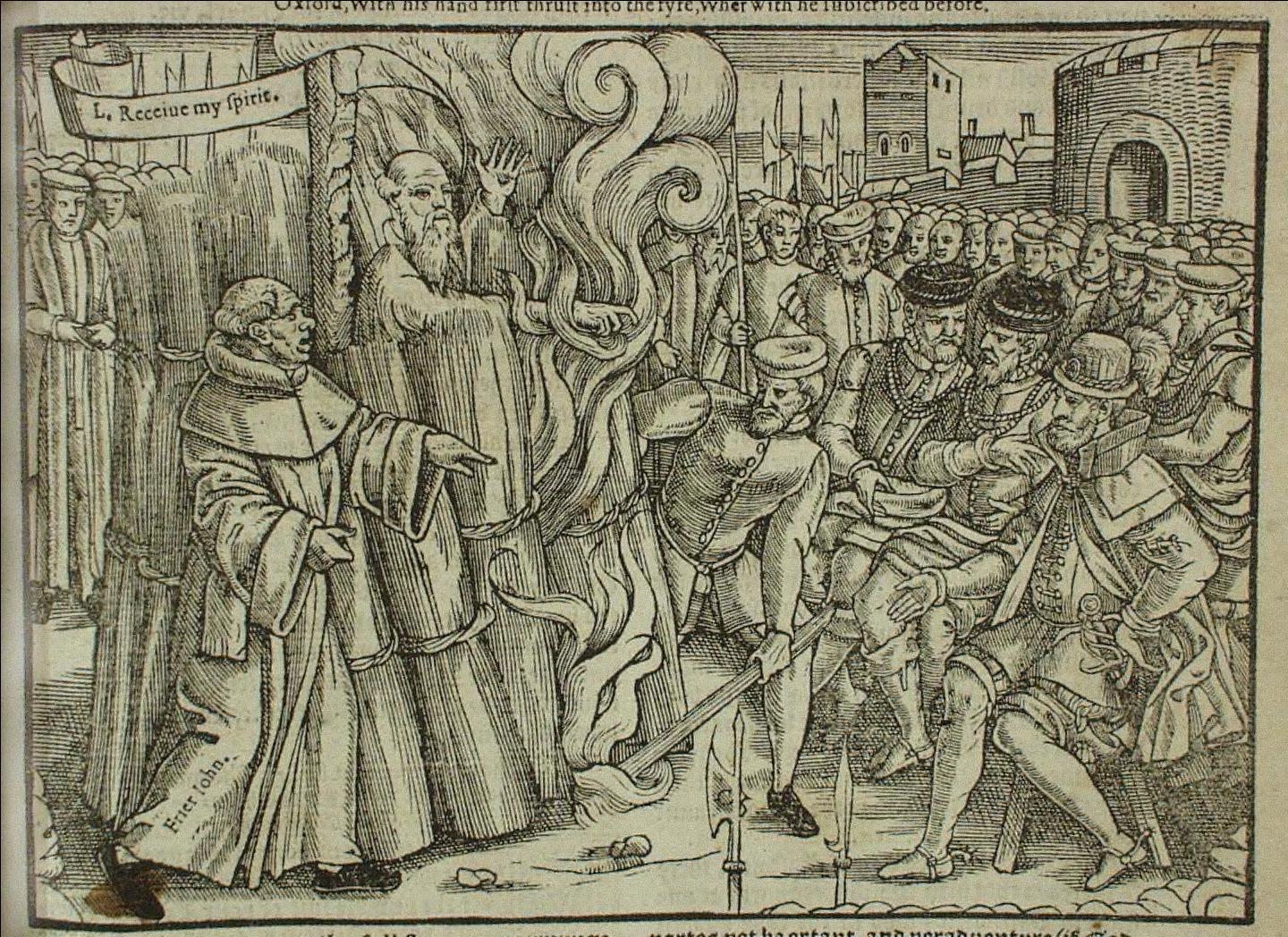
Way back before comic books, there were speech scrolls. This is a woodcut from Foxe's Book of Martyrs, circa 1563. Notice how the scroll comes from the general direction of Cranmer's face. Also, notice the written label on the monk's robe in the bottom left. Here are links to some more woodcuts with speech scrolls from the same book. (Warning: This last one isn't a good idea if you're squeamish or trying to eat -- yes, that is his arm bone down there.)


You may ask, is this why I'm in grad school? Gory renaissance proto-comics? Well, friends, I don't know either.
Sunday, June 21, 2009
leg hair
sometime in October, with the assistance of literary criticism class:
Me: Hey, I don’t like shaving my legs.
My Inner Feminist: Who said you had to?
Me: Um.
My Inner Feminist: . . .
Me: Was it . . . the patriarchy?
My Inner Feminist: Bingo.
Me: Was it an ideology that compels self-modification for women on the assumption of inadequacy and reinforces the to-be-looked-at-ness of the female body?
My Inner Feminist: Yup.
Me: DANG . . .
My Inner Feminist: Dang is right.
Me: So, does that mean I can stop shaving my legs?
My Inner Feminist: Yes, yes it does.
Me: Oh, ok. Well then, I think I’ll stop.
My Inner Feminist: Good job.
November:
Me: I kind of resent that now I can’t shave my legs even if I want to, because you’d make it sound like collusion with the patriarchy.
My Inner Feminist: Tough. Such is the cost of cultural analysis.
Me: Yeah, I know. Fine.
circa January:
My Inner Feminist: How’s the leg hair?
Me: It’s good. I’m actually becoming rather fond of it now that we’re past that awkward prickly stage.
My Inner Feminist: Really? Would you say that it’s growing on you?
Me: Augh, don’t do that to me. You’re supposed to liberate women, not hurt them.
My Inner Feminist: Sorry. But anyway, it’s still winter, so no one has really seen it yet.
Me: Now who’s reinforcing to-be-looked-at-ness?
My Inner Feminist: Just sayin’. This isn’t very gutsy just yet. You going to shave when you wear a skirt?
Me: I dunno. We’ll see.
summer:
Me: Um, so I’m pretty ok with my leg hair now. Yay not having to shave.
My Inner Feminist: Huzzah! Down with the patriarchy!
Me: Hey, I don’t like shaving my legs.
My Inner Feminist: Who said you had to?
Me: Um.
My Inner Feminist: . . .
Me: Was it . . . the patriarchy?
My Inner Feminist: Bingo.
Me: Was it an ideology that compels self-modification for women on the assumption of inadequacy and reinforces the to-be-looked-at-ness of the female body?
My Inner Feminist: Yup.
Me: DANG . . .
My Inner Feminist: Dang is right.
Me: So, does that mean I can stop shaving my legs?
My Inner Feminist: Yes, yes it does.
Me: Oh, ok. Well then, I think I’ll stop.
My Inner Feminist: Good job.
November:
Me: I kind of resent that now I can’t shave my legs even if I want to, because you’d make it sound like collusion with the patriarchy.
My Inner Feminist: Tough. Such is the cost of cultural analysis.
Me: Yeah, I know. Fine.
circa January:
My Inner Feminist: How’s the leg hair?
Me: It’s good. I’m actually becoming rather fond of it now that we’re past that awkward prickly stage.
My Inner Feminist: Really? Would you say that it’s growing on you?
Me: Augh, don’t do that to me. You’re supposed to liberate women, not hurt them.
My Inner Feminist: Sorry. But anyway, it’s still winter, so no one has really seen it yet.
Me: Now who’s reinforcing to-be-looked-at-ness?
My Inner Feminist: Just sayin’. This isn’t very gutsy just yet. You going to shave when you wear a skirt?
Me: I dunno. We’ll see.
summer:
Me: Um, so I’m pretty ok with my leg hair now. Yay not having to shave.
My Inner Feminist: Huzzah! Down with the patriarchy!
Monday, June 08, 2009
strawberry cream cheese the way it was meant to be
1. Toast a bagel.
2. Spread it thickly with cream cheese (real cream cheese, now, none of that diluted spread stuff).
3. Pile on thin slices of fresh strawberries until the bagel is somewhat precarious but not an outright architectural failure.
4. Drip just a little bit of honey on top.
Oh my goodness.
2. Spread it thickly with cream cheese (real cream cheese, now, none of that diluted spread stuff).
3. Pile on thin slices of fresh strawberries until the bagel is somewhat precarious but not an outright architectural failure.
4. Drip just a little bit of honey on top.
Oh my goodness.
Wednesday, May 13, 2009
ethical integration and clarity
Here's something hard I've been thinking about lately. If you have core ethical certainties and you want to do anything about them, you've got to manifest them in specific ways. But, how should you treat your specific course of action differently than you do the ethical core?
This will probably make more sense with an example. At a core ethical level, we've got the principle that (1) all human beings deserve respect as such. Then more specifically we extend the principle to the problem that (2) people are being exploited in sweat shops, and we ought to do something about that. Now in a further extension, many of those I know who raise awareness about the sweat shop issue would also say that (3) the exploitation is a problem of greed caused largely by the capitalist system and further that (4) you also should really buy things made of certified organic hemp fibers.
So what we've got here is a mixture of various ethical levels, and some complications arise when the layers aren't clearly distinguished. Namely, the mixture in this example can alienate people who also respect other humans and also might be willing to do something about sweatshops but who are not Marxists or hippies. It's not fair to imply that (1), (2), (3), and (4) always go together -- and that impression is a danger if they're all presented together without any distinctions. It's a problem to assume that an ethical principle is always bound to one's own methods of executing it.
Of course, it's also a problem if the ethical principle isn't executed at all. You have to have some elaboration or the beautiful abstract principle stays up in Plato's Ethereal Library of Congress for Ideal Forms and doesn't do anybody any good.
But what's more complicated is that the manifestation isn't arbitrary either. Marxists who respect human value establish a connection between human value and Marxist principles. Capitalists who respect human value also connect capitalism with human value. And I don't think the plurality of outcomes allows us to invalidate connections between ethics and method entirely. I might respect these people less if they didn't see a link between their socioeconomics and their convictions.
I guess the thing is that there's a lot of ethically neutral material (personal experience, available information, interpretive approaches, etc.) that intervenes between the principle and the specific course of action. So, while we need to involve ethical convictions in every specific choice, we also need to recognize that the convictions aren't acting in isolation. So perhaps if we recognize the inevitable entanglement of other material with attempts at doing what's right, we can do better at connecting with people who have similar convictions but different practices. Maybe? This is still hard.
This will probably make more sense with an example. At a core ethical level, we've got the principle that (1) all human beings deserve respect as such. Then more specifically we extend the principle to the problem that (2) people are being exploited in sweat shops, and we ought to do something about that. Now in a further extension, many of those I know who raise awareness about the sweat shop issue would also say that (3) the exploitation is a problem of greed caused largely by the capitalist system and further that (4) you also should really buy things made of certified organic hemp fibers.
So what we've got here is a mixture of various ethical levels, and some complications arise when the layers aren't clearly distinguished. Namely, the mixture in this example can alienate people who also respect other humans and also might be willing to do something about sweatshops but who are not Marxists or hippies. It's not fair to imply that (1), (2), (3), and (4) always go together -- and that impression is a danger if they're all presented together without any distinctions. It's a problem to assume that an ethical principle is always bound to one's own methods of executing it.
Of course, it's also a problem if the ethical principle isn't executed at all. You have to have some elaboration or the beautiful abstract principle stays up in Plato's Ethereal Library of Congress for Ideal Forms and doesn't do anybody any good.
But what's more complicated is that the manifestation isn't arbitrary either. Marxists who respect human value establish a connection between human value and Marxist principles. Capitalists who respect human value also connect capitalism with human value. And I don't think the plurality of outcomes allows us to invalidate connections between ethics and method entirely. I might respect these people less if they didn't see a link between their socioeconomics and their convictions.
I guess the thing is that there's a lot of ethically neutral material (personal experience, available information, interpretive approaches, etc.) that intervenes between the principle and the specific course of action. So, while we need to involve ethical convictions in every specific choice, we also need to recognize that the convictions aren't acting in isolation. So perhaps if we recognize the inevitable entanglement of other material with attempts at doing what's right, we can do better at connecting with people who have similar convictions but different practices. Maybe? This is still hard.
Subscribe to:
Posts (Atom)